

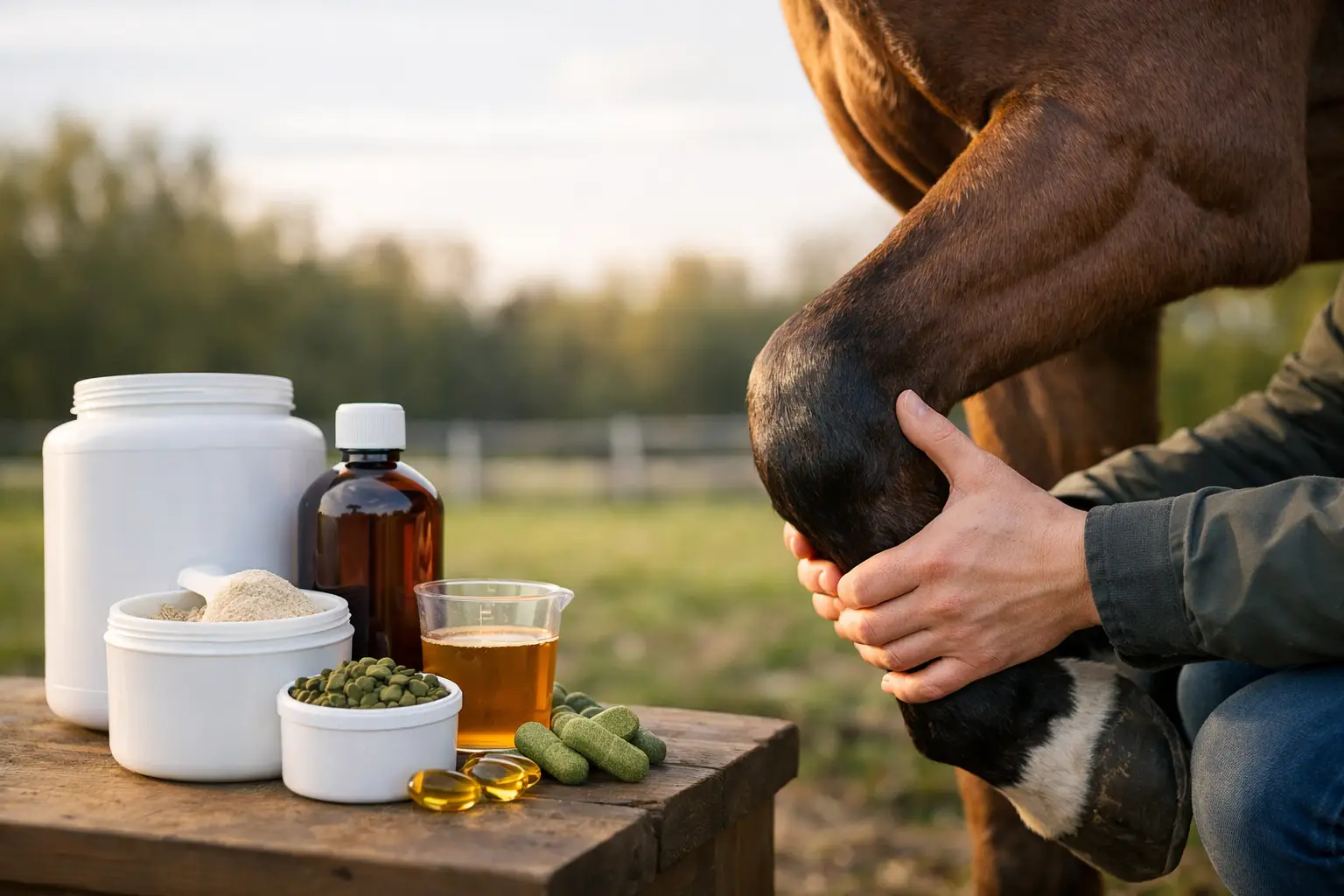
When a horse starts to feel short in the trot, hesitates in turns or seems more stiff after rest, many owners look for supplements for horses with stiff joints. It makes good sense. Stiffness is rarely just a matter of age – it can also be related to the amount of training, surface, recovery, hoof balance and daily feeding. Therefore, the right supplement is not necessarily the most expensive, but the one that suits the horse's needs and is used consistently over time.
When does supplementation for horses with stiff joints make sense?
The first thing many notice is not lameness, but small changes in movement. The horse becomes slower to warm up, loses a little space in the stride or feels less willing in transitions. Some become noticeably stiffer in cold weather, others after hard work or several days in the box.
Here, a joint supplement can be relevant as support in everyday life. Not as a miracle solution, but as part of an overall effort to maintain mobility, comfort and job satisfaction. Older horses in particular, horses in regular training and horses with many years in the sport can benefit from targeted support for joints and connective tissue.
If the stiffness comes on suddenly, is one-sided or develops into obvious lameness, it is not a feeding problem that should be assumed. In this case, the horse should be assessed professionally. Supplementation makes the most sense when you have a handle on the cause and do not overlook anything that requires treatment or changed training.
What ingredients are most often seen in supplements for horses with stiff joints?
The most commonly used ingredients are repeated because they have a clear function in products for mobility and joint comfort. glucosamine is one of the classics. It is often used in joint supplements because it is part of the natural structure of cartilage and is therefore an obvious choice when you want to support the daily load on the joints.
MSM is also very common. Many chooses MSM, when the goal is to support flexibility and daily movement comfort, especially in horses that seem tired or a little heavy in the body after work. It is often seen together with glucosamine, precisely because the two ingredients are used in the same type of products and fit well into a long-term strategy.
Chondroitin is often mentioned in the same context. It is another classic ingredient in joint products and is often chosen for horses where a more complete composition is desired rather than a single substance. Hyaluronic acid is included in some products, especially where a focus on joint flexibility and movement is desired.
Some supplements also contain collagen, herbs or antioxidants. Here the choice depends a lot on the horse. A frugal senior horse in a paddock does not necessarily need the same as a riding horse in permanent work. More content is not automatically better. The decisive factor is whether the composition is targeted, the dosage is reasonable, and whether the product fits into the rest of the feed.
Glucosamine and MSM – that's why many choose this combination
If you look at what horse owners most often ask for, glucosamine and MSM are at the top. This is because the combination is easy to understand and easy to use in practice. It addresses the need that many people have: a horse that is not acutely ill, but which is also not moving quite as freely as before.
For many, it is an advantage to start simple and choose a product where they key ingredients are already put together in a convenient daily dosage. This makes it easier to be consistent, and consistency matters a lot. Joint supplements don't work overnight. They are typically evaluated over weeks, not days.
How to choose the right joint supplement
The best choice starts with an honest look at the horse. Is it an older horse that has become stiff with age? An active riding horse that is regularly exercised? Or a horse that has been out of shape and now needs to get back into shape? The purpose of the grant should guide the choice.
For mild stiffness and daily maintenance, a simple, targeted product can often be enough. For more pronounced needs, many choose a broader formulation with more classic joint ingredients. This can be relevant, but only if the dosage is still transparent and you know what you are paying for.
Also look at ease of use. Powder, pellets or liquid form can make a real difference if the horse is picky. A good product won't help much if it gets sorted out in the manger. Here simplicity is a strength.
Quality also matters. For horse owners who want stable solutions rather than quick purchases, it is an advantage to choose products from serious suppliers with a focus on pure raw materials and uniform production. This provides more security in daily use and makes it easier to continue a course long enough to properly assess the effect.
That subsidy cannot handle it alone
Even the best supplement for horses with stiff joints cannot compensate for a daily routine that works against the horse. If the hooves are out of balance, the saddle is uncomfortable, or the training is too monotonous, the stiffness will often keep coming back. The same goes for too much or too little exercise.
Many horses benefit from regular, calm movement rather than long breaks and hard peaks. A good warm-up, suitable surface and time for recovery is rarely the most exciting advice, but it is often the most effective. Supplements work best when they support a sensible everyday life and are not meant to save a bad routine.
Weight also plays a role. Extra pounds put a strain on joints and the musculoskeletal system, and for some horses it is surprisingly helpful to adjust the feeding plan so that the body can work more easily. Here it makes sense to think holistically rather than just in terms of one product.
When can you expect to see a difference?
This is one of the most important questions because many give up too early. Joint supplements are typically evaluated over 3 to 8 weeks, depending on the horse’s starting point, age and workload. Some owners notice small improvements earlier – a freer gait, better willingness or less stiffness at start-up – but the most fair assessment requires patience.
It helps to track changes systematically. Not necessarily with advanced schedules, but by noticing the same situations week after week. How does the horse feel in the first ten minutes? Is it easier to bend on both sides? Does it start faster after a day off? Small improvements count.
If no difference is seen after a reasonable period of time, it may be a sign that the product is not suitable for the horse, that the dosage is too low, or that the cause of the stiffness lies elsewhere. This is not a defeat. It is just a sign that the next step needs to be more precise.
A realistic look at expectations
There is good reason to be positive, but also to be sober. A joint supplement can support mobility, flexibility and comfort in everyday life. It can make a noticeable difference for the horse that has become stiffer with age or needs extra support in training. But it is no substitute for investigation, proper management or targeted treatment when the problem is more serious.
That's why the best results are often seen with owners who are consistent and practical. They choose a well-thought-out product, stick to it, adapt training and pay attention to the small signs. That approach rarely makes dramatic headlines, but it often results in more mobile and happier horses over time.
At Strohmedico, the focus is precisely on functional support that fits into everyday life and helps maintain mobility and quality of life - also when it comes to horses that need to be kept running well for many years to come.
When choosing supplements, think less about quick wins and more about what can realistically help your horse move better tomorrow, next month and next season.