

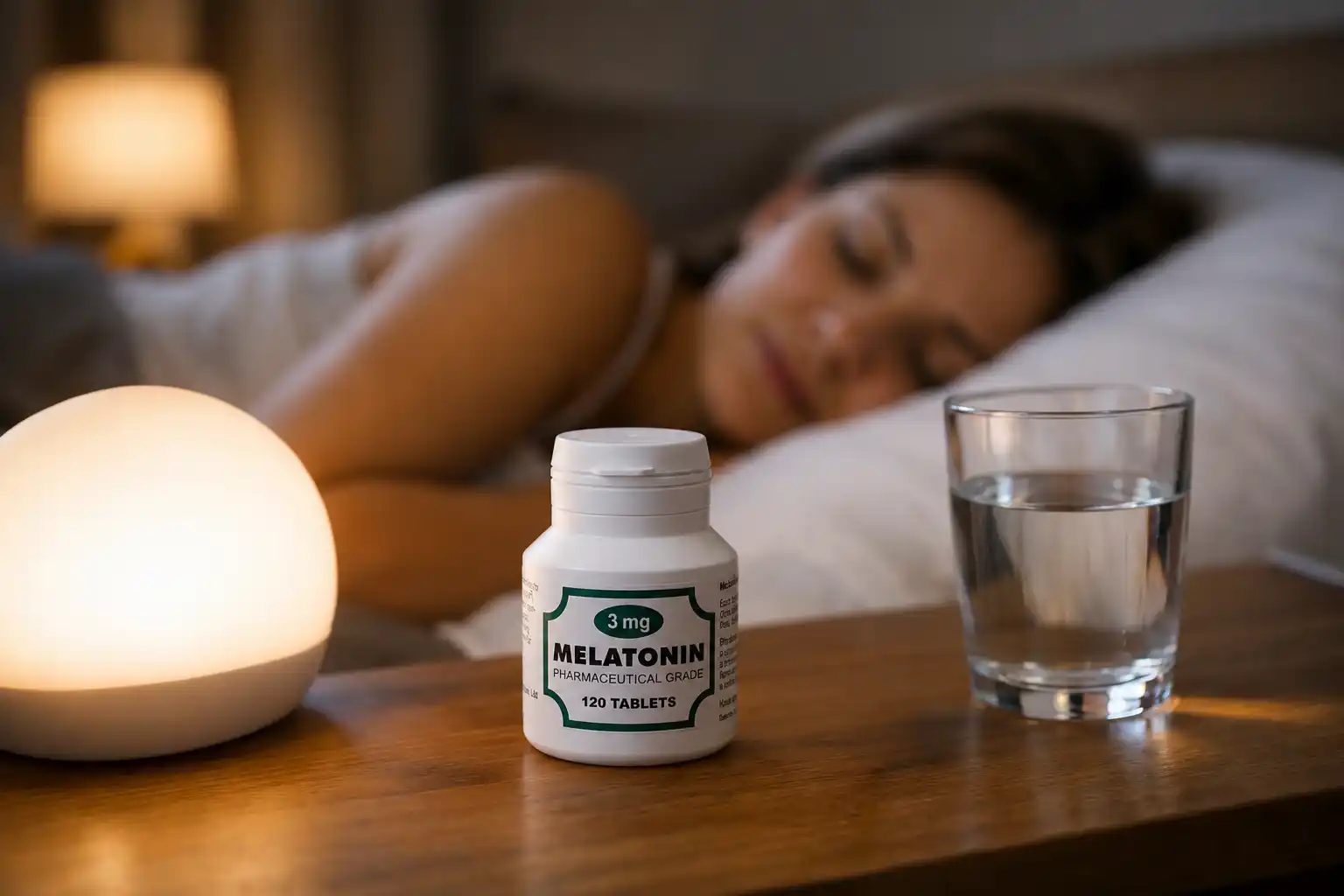
It's 3:17 a.m. You're tired, but your brain keeps going, and the next day will be another day with a heavy head, less energy and shorter patience. For many adults, this is where the question of melatonin for sleep problems becomes concrete – not as a trend, but as a real desire to fall asleep on time and wake up with more energy.
For many, it makes the most sense to choose a product that is easy to use in the evening. See our melatonin for the evening routine.
Sleep problems affect people in different ways. Some people cannot fall asleep even though their bodies are tired. Others wake up too early or experience their circadian rhythm slipping later and later. This is where melatonin often comes into play, because it is not primarily a classic sleeping pill, but a signaling substance that the body itself uses to regulate sleep and circadian rhythm.
When does melatonin make sense for sleep problems?
Melatonin can be particularly relevant if the problem is timing. If you find yourself getting sleepy too late, having trouble settling down in the evening, or feeling that your rhythm is out of balance, melatonin can be a useful tool. This also applies to jet lag or changing circadian rhythms, where the body has difficulty returning to a stable sleep pattern.
This does not mean that melatonin will solve all types of poor sleep. If you fall asleep quickly but wake up many times due to pain, stress, restless legs, snoring or nighttime toilet visits, the picture is different. Here, your sleep may be affected by something that requires a solution other than a supplement.
For many in the adult and mature age group, the challenge is precisely that sleep no longer comes as naturally as it used to. You get tired, but not at the right time. And when you miss sleep several nights in a row, it is quickly felt in everyday life – less energy, weaker concentration and less energy to stay active.
How melatonin works in practice
Melatonin is produced naturally in the body, especially when it gets dark. It tells the body that night is approaching and helps prepare for sleep. Therefore, the effect is very much about rhythm and signals – not about knocking you out.
This is also why timing is so important. Taking melatonin at the wrong time can result in less than optimal results or even disappointment. Taking it correctly in relation to your sleep pattern can help your body find a more stable bedtime.
Many people expect a dramatic effect the first night. This is not always the case. For some, the difference comes quickly. For others, it is more about the evening becoming calmer and that over a few days it becomes easier to fall asleep at a more reasonable time. This is an important nuance, because melatonin works best when expectations are realistic.
What can you expect – and what can't you?
If your main problem is difficulty falling asleep, melatonin can make a noticeable difference. You may find that you fall asleep earlier and that your sleep window becomes easier to hit. This can lead to a better start to the night and ultimately better days.
But melatonin is not a guarantee of a perfect night. It does not automatically eliminate stress, worries or restless habits in the evening. It also may not help if you drink a lot of coffee late at night, use screens close to bedtime or get up at very different times from day to day.
Therefore, it makes the most sense to see melatonin as part of a simple, targeted sleep strategy. Not as a miracle solution, but as a practical tool to support the body's own rhythm.
Melatonin for sleep problems in adults over 40
The older you get, the more common it is to experience changes in your sleep. Some people get tired earlier and wake up earlier. Others feel tired all day but still can't fall asleep properly at night. At the same time, everyday life can be full of factors that disrupt sleep – responsibilities, pain, worries or changed habits.
Here, melatonin appeals to many because it is a simple solution that fits into a regular routine. If the goal is to maintain energy, drive and freedom in everyday life, sleep is not a luxury. It is a prerequisite. Good sleep makes it easier to stay active, think clearly and get through the day well.
That's why many people no longer see sleep support as something you only use during stressful periods. It's about quality of life. When the nights get better, it becomes easier to maintain good habits around exercise, mood and daily energy.
How to use melatonin wisely
The biggest mistake is often to take melatonin randomly. If you want real effect, you need to use it consistently and with a focus on the time. It makes the most sense to take it in the evening well before your desired bedtime, so that the body has time to perceive the signal.
It also helps to make the rest of the evening more sleep-friendly. Dim lights, less screen time, regular routines, and a fairly consistent bedtime make a big difference. When your body gets the same signals over and over again, melatonin works better with your habits.
If you change your bedtime too much from day to day, you often counteract the effect. Sleep rhythm is largely a matter of repetition. Therefore, the best use of melatonin is often the simplest: the same time, the same evening routine, and a little patience.
When should you think in other directions?
If your sleep problems have been going on for a long time, or if they are accompanied by pronounced restlessness, pain, sadness, breathing pauses, nocturnal palpitations or extreme daytime fatigue, you should not just experiment on your own. Sleep problems may be a symptom of something else, and it is important to clarify the cause.
The same applies if you are already taking medication or have a health condition that requires special attention. Here it is wise to get an individual assessment so that you choose a solution that suits your situation.
So there is a clear "it depends". Melatonin is most obvious when the problem is about falling asleep and rhythm. For more complex sleep problems, the solution often needs to be broader.
What should you look for when choosing a product?
When choosing melatonin, quality and simplicity are more important than fancy promises. A product should be easy to use, fit into your evening routine, and come from a serious supplier with a focus on quality. For many consumers, it also matters that the products are produced according to proper standards in the EU and that it is easy to order without unnecessary intermediaries.
Practicality matters more than many people think. If it is difficult to get hold of the product, or if the information is unclear, it becomes more difficult to maintain a stable routine. That is why many adult customers choose a supplier that makes it easy to find products according to their needs – such as better sleep, more peace of mind and more energy in everyday life. At Strohmedico, that approach is central: clear solutions for specific goals.
The best effect often comes from simplicity
Many people chase the perfect sleep solution and end up with too much advice at once. This is rarely necessary. If you want to improve your sleep, it is often enough to start simple: a fixed rhythm, less light late at night and melatonin used at the right time.
When it works, it's not just felt at night. It's felt when you wake up with a little more strength in your body, a little more desire to move and a little more energy for the things you want to keep in your life. Sleep is closely linked to freedom in everyday life – the freedom to function, think clearly and hold on to your energy.
If you're considering melatonin for sleep problems, don't just think about falling asleep faster. Think about what better sleep will give you tomorrow.
Also read our article about sleep routines
Also read our article about New sleep trends for adults
About Strohmedico
Strohmedico is a European webshop focusing on dietary supplements produced in the EU. We write about ingredients, nutrition and products that can be part of a healthy and active lifestyle.