

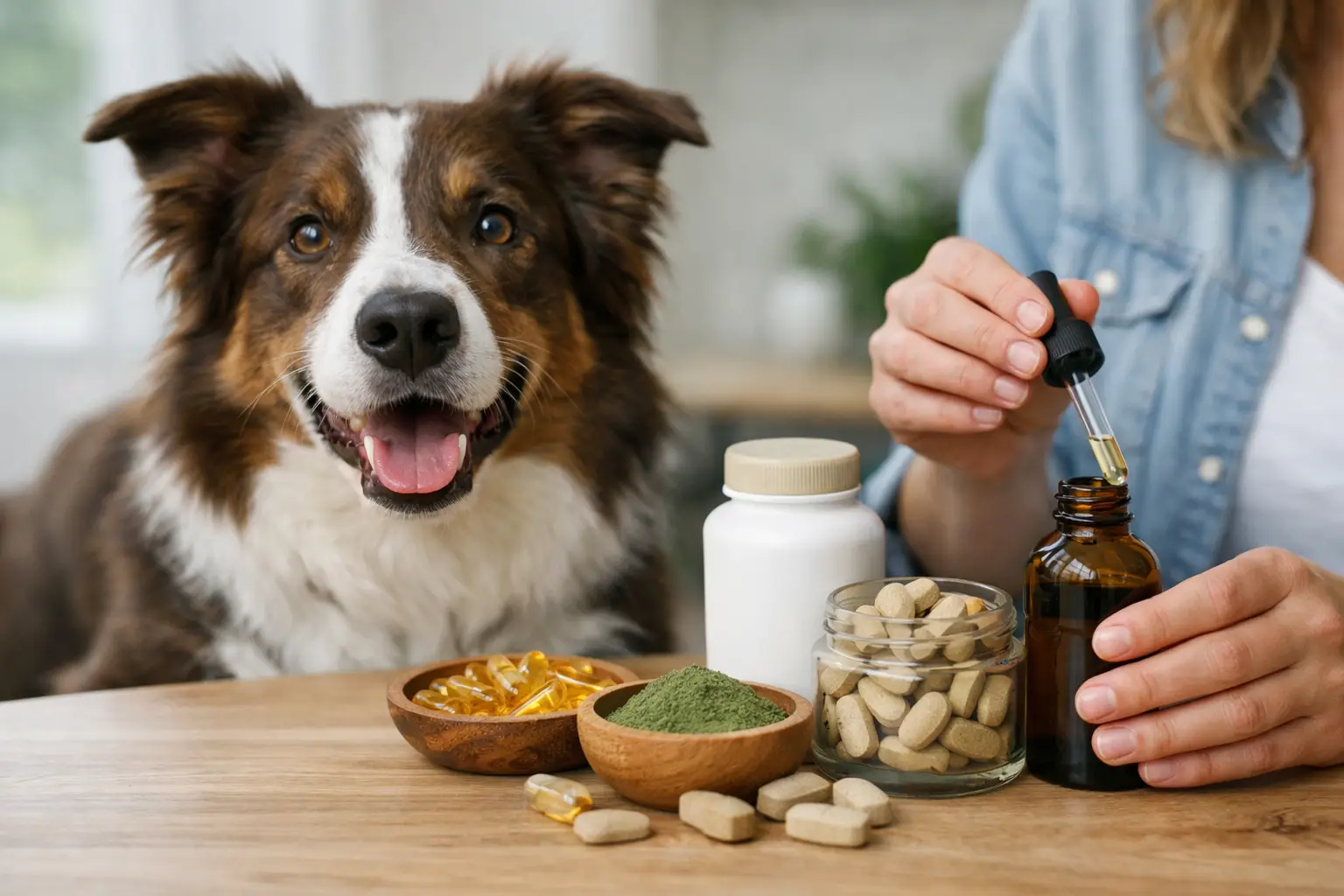
When a dog becomes stiff after rest, licks its paws, sheds more than usual or loses energy, the question quickly arises: which supplement is good for dogs? The right answer does not depend on fashion products, but on the dog's age, stress and the specific problem you want to support. A good supplement must fit the need - otherwise you will pay for something that does not make enough difference in everyday life.
Many dog owners buy too broadly. They choose a little for the coat, a little for the joints and a little for the stomach, without knowing what is actually most important. This rarely gives the best effect. A safer way is to start with the dog's symptoms and from there choose a functional supplement with a clear purpose.
What supplement is good for dogs with stiff joints?
Joints and mobility are one of the most common areas where dogs benefit from supplementation. This is especially true for older dogs, large breeds, and active dogs that put a lot of strain on their bodies. If your dog is slow to get up, hesitant on stairs, or no longer jumping up like they used to, this is often where you should start.
Glucosamine is one of the most used choices for dogs with joint challenges. It is typically used to support cartilage and mobility and is often chosen for incipient stiffness or as daily maintenance in senior dogs. MSM is often combined w/ glucosamine, because many dog owners find that the combination provides more noticeable support for agility and comfort in movement.
However, needs differ. A younger dog in hard training may benefit from preventative support, while an older dog with obvious stiffness often needs a more targeted solution over a longer period of time. Patience is important here. Joint supplements rarely work overnight. You best assess the effect over several weeks, not several days.
When mobility means quality of life
For many owners, joint supplements are not just about going for longer walks. It's about freedom in everyday life. That the dog still wants to go out, still gets up without difficulty and still wants contact and activity. When mobility decreases, the joy of life often decreases with it.
That's why it makes sense to choose a supplement with proven ingredients and a composition that is specifically designed for mobility. Not just a general multivitamin, but a product with a clear goal.
Which supplement is good for dogs with skin and coat problems?
If the coat appears dull, the skin is dry, or the dog is scratching more than usual, the need points in a different direction. Here fatty acids are often relevant. Omega-3 in particular is used by many dog owners to support skin balance and coat quality.
However, it is important to be realistic. A supplement can support the skin, but it does not solve everything. Itching can also be related to food, environment, season or underlying irritation. If the problem is persistent or severe, you should not only think about supplements. You should also consider whether the dog should be further evaluated.
That said, the right supplement can make a significant difference in mild to moderate cases. Especially in dogs with dry skin, seasonal shedding or needing extra support during molting periods. Quality is crucial here. A cheap product with low content rarely has the same effect as a well-thought-out solution with high purity and stable dosage.
Signs that your skin may need support
Some signs are easy to miss because they come on gradually. The dog scratches a little more, the coat loses its shine, or small dry areas appear. This does not necessarily mean illness, but it is often a signal that the body needs better balance and more targeted support.
Supplements for the stomach and immune system
A sensitive stomach affects the dog's overall well-being. Loose stools, upset stomachs or changing appetites can be stressful for both dog and owner. Here, many choose a supplement with a focus on intestinal flora and digestion. Probiotic products or compounds that support stomach balance may be relevant, especially after a change in food, periods of stress or antibiotic treatment.
Immune system is closely linked to the dog's overall resistance. Some dogs need extra support during periods of high stress, cold, recovery or old age. Here, vitamin and mineral supplements may be relevant, but only if given with care. More is not always better. Excessive supplementation levels may be unnecessary and in some cases inappropriate.
The best choice is therefore rarely the most comprehensive product on the shelf. It is the supplement that matches the dog's current situation.
Should all dogs have vitamins?
No, not necessarily. If a dog is eating a good quality complete food and is doing well, there is not always a need for an additional multivitamin. Many owners believe that more vitamins automatically give more energy and better health, but that is not how it works. Supplements should have a purpose.
Where vitamins and minerals may be relevant are, for example, special needs, a one-sided diet, old age or periods of increased stress. This also applies to dogs that are fed homemade food, where the balance of nutrients may be more difficult to ensure. Here, a targeted supplement can provide more security and better coverage.
Which supplement is good for dogs of different ages?
Age is a big factor in your choice. Puppies have different needs than adult dogs, and senior dogs often need more support for joints, energy, and recovery. Therefore, you shouldn't choose a supplement based on age alone, but you should use age as an important part of the assessment.
A young and healthy dog rarely needs much more than good nutrition and a stable activity level. An active adult dog may benefit from joint support during sports, hunting or hard training. An older dog often benefits from products that support mobility, comfort and daily vitality.
With senior dogs, it makes especially good sense to get out early. Many wait until the dog is clearly in pain. But the sooner you support the body, the better chance you have of maintaining function and quality of life for longer.
The most important thing is not the dog's age alone
Two dogs of the same age can have very different needs. One runs effortlessly and maintains weight, the other is stiff, heavy and tires quickly. That's why you should always look at behavior, movement, appetite and coat – not just the date of birth.
How to choose right the first time
If you want to avoid buying the wrong thing, start with one question: What do you want to improve? Is the goal better mobility, a calmer stomach, a stronger coat or more energy in everyday life? Once you have answered that, the choice becomes much simpler.
Then look at the ingredients. A good supplement has active ingredients that match your needs, and the dosage should be clear. Be skeptical of products that promise everything at once. It sounds smart, but often ends up being too broad to be truly effective.
You should also consider whether the supplement is realistic to give every day. If the dog won't take it, you won't get any effect. Taste, format and ease of dosing are therefore more important than many people think.
With a specialized player like Straw Medico The advantage is that the range is typically built around specific needs rather than random categories. This makes it easier to choose by function and not just by the name on the packaging.
When should you expect results?
It depends on the type of supplement. Support for the stomach and digestion can in some cases be felt relatively quickly. Supplements for joints, skin and fur often require longer. Here, 3 to 8 weeks is a more realistic window before you can properly assess the difference.
It is also worth remembering that supplements work best as part of a whole. Weight, exercise, food quality and daily stress all matter. An overweight dog with worn joints will rarely get the full benefit of a good joint supplement if the overall stress is not reduced at the same time.
Therefore, the strongest choice is often not to buy the most possible, but to buy most precisely.
If you're wondering which supplement is good for dogs, think less about trends and more about function. When you choose based on your dog's real needs, supplements don't just become another product in the cupboard - they become practical support for many good years of movement, energy and presence.