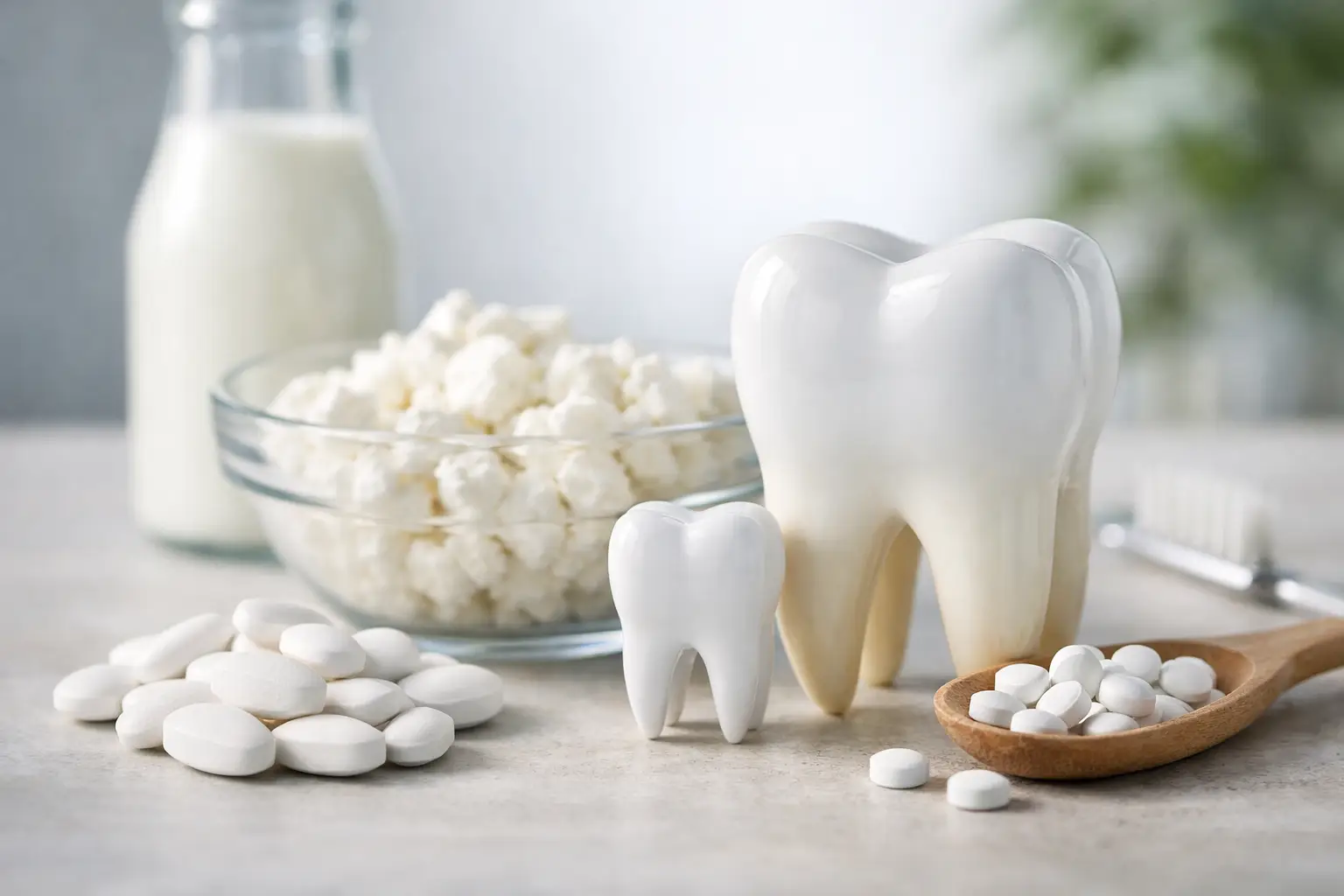
When your gums start to recede or your teeth start to feel more sensitive, the question quickly arises: is calcium good for your teeth? The short answer is yes – but not quite as simple as many people hope. Calcium plays an important role in strong teeth, but it works best as part of a bigger picture, where vitamin D, diet, oral hygiene and age also play a role.
Is calcium good for teeth – and why?
Yes, calcium is good for teeth because the mineral is a central building block in both teeth and bones. The hard structure of teeth is largely dependent on minerals, and calcium is one of the most important. When the body has access to enough calcium, it is better equipped to maintain strong tooth structures throughout life.
However, this does not mean that extra calcium will automatically give you healthier teeth overnight. If you already meet your needs through your diet, the effect of a supplement is not necessarily dramatic. Conversely, too low an intake over time can be a real challenge – especially if you also get too little vitamin D, are older or generally focus on maintaining bone strength and vitality.
For many adults, it is not about a quick fix, but about supporting the body consistently. This is especially true during periods when you want to prevent weakness and maintain strength in everyday life.
Teeth need more than just calcium
If you only look at calcium, you often overlook what determines whether the body can actually use it effectively. Vitamin D is the most obvious example. Without enough vitamin D, calcium absorption is impaired, and you don't get the same benefit from either diet or supplements.
In addition, playing phosphorus and magnesium also into the mineral balance. At the same time, oral hygiene is absolutely essential. You can eat sensibly and still have problems with your teeth if plaque is allowed to remain or if the gums are irritated for a long time.
This is precisely why adults with a focus on bones, teeth and active aging often benefit from thinking more holistically. It's about supporting the body functionally – not just about one nutrient in isolation.
Calcium alone does not protect against all dental problems
It's worth being honest here: calcium does not in itself prevent cavities, tartar, or gum disease. Cavities primarily occur when bacteria in the mouth metabolize sugar and form acids that attack the enamel. Here, brushing your teeth with fluoride, good habits, and limiting frequent sugar intake are still key factors.
Calcium is therefore most relevant as part of the long-term strength of teeth and jaws. This makes it important – but in a different way than many people think.
Who should pay extra attention to calcium?
Some groups have more reason to monitor their calcium intake than others. This is especially true for adults and the elderly, where a focus on bone strength becomes more relevant with age. As the body changes and bone mass can naturally decline, it becomes more important to ensure a stable intake of the nutrients that support strength and function.
Postmenopausal women are an obvious group because hormonal changes can affect bone strength. People who avoid dairy products or eat a very monotonous diet may also be at risk of getting too little calcium. The same applies if their appetite has decreased or their diet has become more restricted over time.
For this target group, the question of whether calcium is good for teeth is often also about something bigger: how to best maintain freedom, strength and quality of life in everyday life. Teeth are part of the big picture. When they function well, it is easier to eat a varied diet, chew properly and stick to good habits.
Can you get enough calcium through your diet?
Yes, many people can meet their needs through their diet. Dairy products such as milk, yogurt and cheese are classic sources, but calcium is also found in green vegetables, almonds, sesame and certain fortified products. The challenge is that it requires a bit of overview and regularity.
For some it works fine. For others it becomes more fluctuating in practice. If you eat small portions, skip meals or deliberately avoid certain foods, it can be difficult to be sure that the level is stable enough over time.
Here, a calcium supplement can be a practical solution. Not because everyone needs it, but because for some it provides simple, daily support that fits better with reality than a perfect diet plan. This is especially relevant if you are already focused on bones, mobility and healthy aging.
When do subsidies make the most sense?
Supplements typically make the most sense when the diet does not cover the needs well enough, or when you want to be extra careful during periods of increased stress. focus on bone strengthIt may also be relevant if you take vitamin D and want to better support the body's overall mineral balance.
What is important is quality, dosage and regularity. More is not always better. Too high doses are not necessarily an advantage, which is why it makes sense to choose products with a clear and transparent composition that fits into daily use.
What does your body say if you get too little?
Too little calcium is not always immediately noticeable. This is one reason why deficiency can creep in over time. The body prioritizes important functions, and if intake is too low, it can start to draw on its stores.
There may not be a direct correlation between calcium intake and dental problems from week to week. However, in the long term, inadequate intake may be part of a pattern where strength and maintenance are not optimal. This is especially true in conjunction with low vitamin D, advanced age, or generally low mineral status.
That's why it makes sense to think preventively. Many people wait until problems have become noticeable. But when it comes to bones and teeth, long-term efforts are often the most valuable.
How to best support your teeth in everyday life
If your goal is to take better care of your teeth, calcium is a good part of the plan – but only one part. The strongest starting point is a combination of daily habits that can actually be maintained.
Start with your diet. Make sure you eat regular meals with calcium-rich foods, and consider vitamin D, especially during periods when the sun is not providing enough. Brush your teeth thoroughly with fluoride toothpaste, and be aware of small habits such as frequent sweet snacks, sodas, and acidic drinks over many hours.
If you already know that your diet fluctuates, or if you want to do something active to support bones and teeth as you age, a targeted supplement can be a simple solution. At Strohmedico, it is exactly the type of functional support that many are looking for: products that fit into everyday life and help maintain strength and independence for longer.
Is calcium good for teeth in the elderly?
Yes, and perhaps even more relevant than earlier in life. As we age, it becomes more important to maintain both bone strength and good chewing function. Teeth must withstand the strain of everyday life, and the jawbone also plays a role in the overall foundation.
This doesn't mean that calcium alone can solve age-related oral challenges. But it can be an important support at a stage in life when many people are becoming more conscious of staying active, strong and independent. It's the type of prevention that rarely feels dramatic here and now, but can make a real difference over time.
For older adults, it is especially worth looking at the whole picture: do you eat a varied diet, do you get vitamin D, do you take care of your oral hygiene, and is your calcium intake stable? When those pieces fall into place, your teeth typically look better.
The honest answer
So is calcium good for teeth? Yes, absolutely. Calcium is an important building block for strong teeth and a relevant focus if you want to take care of your oral health and your strength as you age. But the best results come when calcium is part of an overall effort with vitamin D, good oral hygiene and daily habits that actually last in the long run.
It doesn't have to be complicated. Small, stable choices are often the ones that pay off the most – even when the goal is to preserve teeth, strength and quality of life for many years to come.