

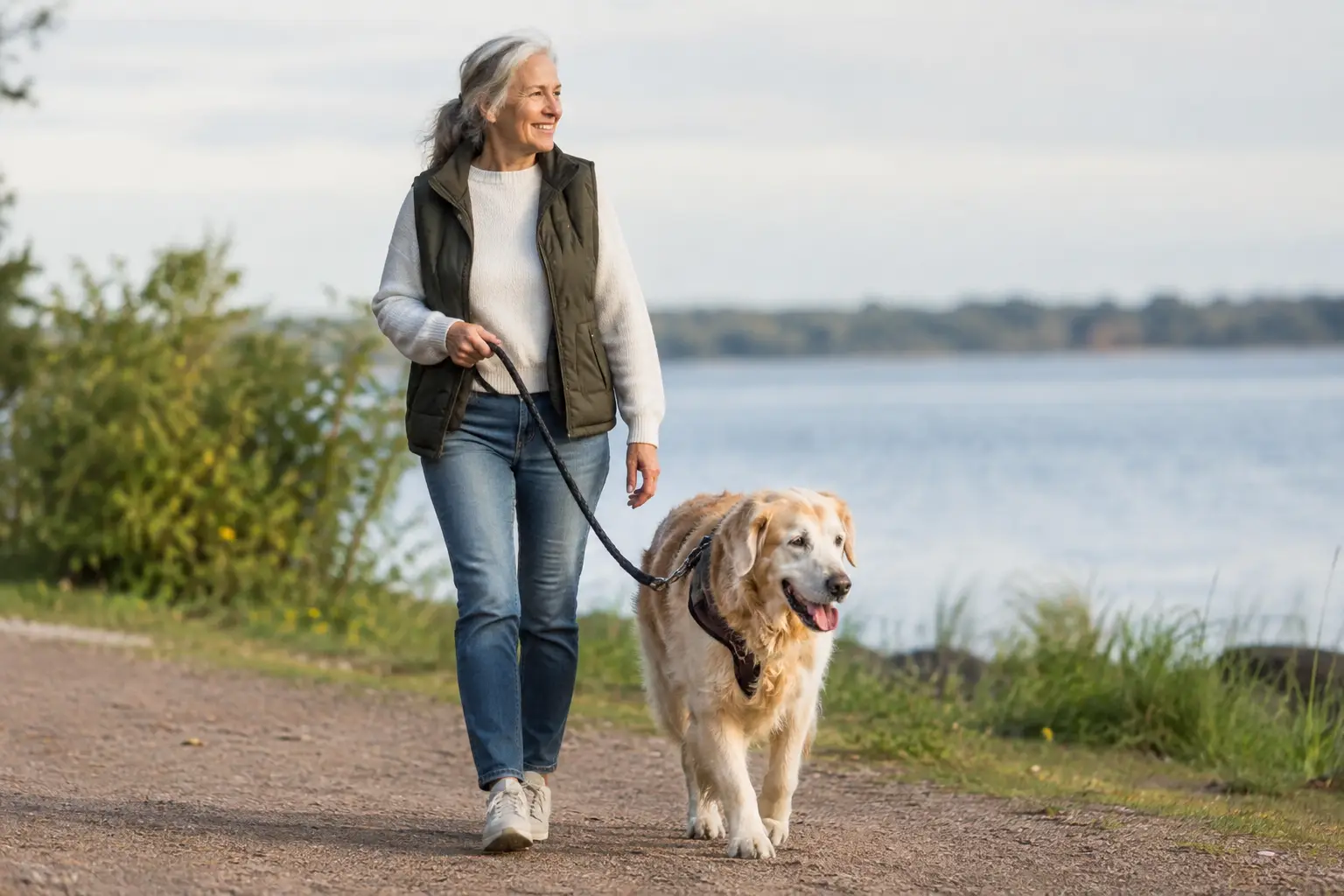
When a dog starts to hesitate on the stairs, takes a little longer to get up after resting, or no longer runs to the door with the same speed, it's easy to chalk it up to age. However, a concrete example of mobility in a senior dog shows why small changes are worth noting. Mobility is not just about the pace of the walk, but about the dog's ability to move safely, naturally, and with joy throughout the day.
For many dog owners, the change comes gradually. The dog may eat as usual, enjoy contact and want to go out, but it chooses a shorter route, avoids jumping into the car or changes position in the basket frequently. This is not a diagnosis in itself, but it is relevant information about the dog's everyday life and well-being.
An example of mobility in a senior dog
Imagine a 10-year-old medium-sized dog who used to jump out of the car and run up the stairs without thinking. Over a few months, he starts to put his front paws on the bumper and wait for help. On a morning walk, he walks fine for the first few minutes, but slows down after a while. At home, he still likes to lie down with his family, but he gets up from his blanket more cautiously.
This example of mobility in a senior dog is not about a single movement. It is the pattern that is relevant: several small situations where the dog chooses a more cautious solution. Some days may be better than others, depending on the surface, weather, activity the day before, body weight and the dog's general condition.
This does not mean that all older dogs should be spared exercise. On the contrary, many senior dogs benefit from calm, regular walks, where the length and pace are suitable for the individual dog. The goal is not to maintain the same activity level as in the young dog years, but to support an everyday life in which the dog can continue to participate in a good way.
How reduced mobility manifests itself in everyday life
In a senior dog, changes are often most evident in transitions. This may be when the dog stands up, turns around, goes from carpet to smooth flooring, or gets in and out of the car. On a regular walk, the signals may be more subtle because the dog is still motivated by scents, people, and familiar routines.
Pay special attention to any changes in the way your dog uses the home. He may stand in front of the sofa instead of jumping up, avoid a particular staircase, or choose to lie down in a different place than before. Some dogs also walk more cautiously on slippery floors, while others have difficulty keeping their balance when turning quickly.
Behavior can also play a role. A dog that used to love playing rough with other dogs may prefer shorter encounters or take more breaks. This can be a wise choice on the dog's part. There is a difference between encouraging appropriate activity and forcing the dog into situations it no longer thrives in.
Age depends on breed and size
A senior dog is not necessarily a specific age. Small breeds often age later than large breeds, and individual differences matter a lot. An active dog of eight years may have different needs than a calm dog of twelve years. Therefore, it is more useful to look at changes in the normal movement pattern of the individual dog than to compare with a fixed age limit.
A quick note on your phone can be a simple help. For example, write down whether your dog hesitates on the stairs, how long he walks with pleasure, and whether he seems different after an active day. Over a few weeks, such observations can make it easier to see whether it is a one-off bad day or a development that should be discussed with your vet.
Make everyday life easier without making it stagnant
Small practical adjustments can make a big difference to an older dog's daily routine. A non-slip rug in areas where the dog often gets up or turns can provide a safer surface. A ramp for the car can be relevant for dogs who no longer have to jump up and down, while a good, supportive resting place can make breaks more comfortable.
Walks don't always have to be long to be meaningful. Several shorter walks with time to sniff are better for many senior dogs than one long, fast-paced walk. Sniffing, calm fetch games, and simple exercises that the dog knows can also provide activity without great strain.
However, it is important not to change everything at once. If the dog is still moving well and wants to participate, too many restrictions can lead to a more passive everyday life. Therefore, adapt according to the dog's signals and the specific situation. On cold, wet or slippery days, the need for a calmer routine may be greater than on a dry day with firm ground.
Weight, food and daily routine
Body weight is a practical factor to consider when assessing your dog's movement. A weight that is appropriate for your dog's size and build makes it easier to maintain an active lifestyle. If you are unsure whether your dog's food portions are appropriate for their activity level, your veterinarian or a nutritionist can help with a specific assessment.
Some dog owners choose supplements with ingredients like glucosamine, MSM, omega-3 or selected vitamins and minerals as part of the daily feeding routine. Products for animals should always be selected according to species, size and recommended dosage. Dietary supplements are a supplement to a complete food and should not replace a varied, balanced diet or professional advice.
Se glucosamine og MSM here.
Especially if your dog is on medication, has known health conditions, or has a sudden change in behavior, you should talk to your veterinarian before changing food or adding supplements. This also applies if you are considering products intended for humans. Dogs have different needs, and product choices should be based on the dog rather than human routines.
When should you contact the vet?
Gradual aging is normal, but significant or sudden changes in mobility should always be taken seriously. Contact your veterinarian if your dog suddenly refuses to support a leg, has difficulty getting up, falls, changes in appetite, or seems unusually quiet. The same goes for if they react strongly when you touch a particular area, or if their gait changes noticeably.
A veterinary assessment can help clarify what is behind the change and what considerations are appropriate for your particular dog. Please include your observations: When do you see the change, which movements are most difficult, and is there a difference between morning and evening? The more specific you can describe your daily routine, the better the basis for advice.
Monitoring a senior dog's mobility doesn't require looking for faults in every single movement. It's about knowing your dog well enough to notice when they change habits. Calm adjustments, appropriate activity, a safe home, and professional sparring when needed can help maintain good times together – even when the pace changes a bit.
About Strohmedico Strohmedico is a European webshop focusing on dietary supplements produced in the EU. We write about ingredients, nutrition and products that can be part of a healthy and active lifestyle.