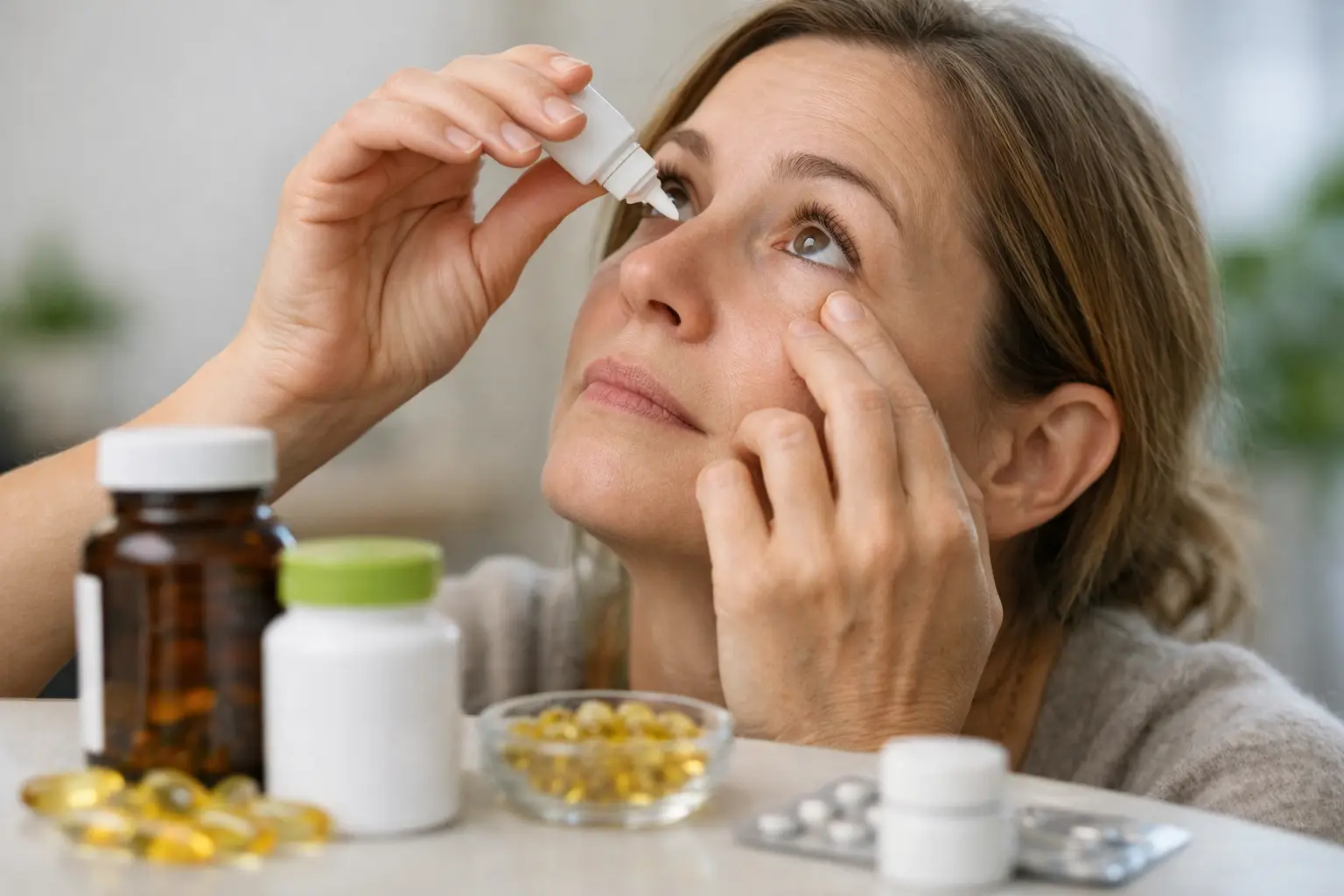
When your eyes burn from the screen, run in the wind or feel tired already in the morning, many people start looking for the best supplement for dry eyes. It makes sense. Dry eyes are not just a minor irritation. They can affect reading, driving, working at the computer and the general comfort of everyday life.
Many people start with eye drops, and this can be a great solution for quick relief. But if the problem returns again and again, it is obvious to look at whether the eyes also need support from the inside. Here, supplements are interesting because they work with the factors that are important for the tear film, mucous membranes and the general balance of the eye.
Best Supplements for Dry Eyes – The Most Relevant Ingredients
There is no single supplement that works for everyone. Dry eyes can be caused by age, a lot of screen time, dry air, contact lenses, hormonal changes, or decreased tear film quality. So it's less about miracle cures and more about choosing the ingredients that suit your situation.
For most people, omega-3 is the first place to look. Omega-3 fatty acids, especially EPA and DHA, are often associated with supporting the surface of the eye and a more stable tear film. If your eyes feel gritty, irritated, or tired at the end of the day, this is exactly the type of support many are looking for. It’s also an obvious choice for adults who want a convenient solution that can fit into their daily routine.
Another relevant group is vitamins and antioxidants, especially vitamin A. Vitamin A plays a role in normal mucous membranes, and this is important because the surface of the eye depends on a well-functioning environment. If you have a diet with limited variety, it may be worth considering whether you are getting enough. However, it is important not to just take high doses on a whim. More is not always better.
Zinc and certain antioxidant combinations may also be relevant, especially if you want broad support for the normal function of the eye. They are rarely the first choice alone against dryness, but they can make sense as part of a comprehensive solution that considers comfort, vision and daily maintenance.
Omega-3 is often the first choice for dry eyes
If one had to point to the most obvious place to start, omega-3 is for many the best supplement for dry eyes. This is not due to fashion or quick promises, but because omega-3 is often chosen precisely for problems with dryness, irritation and unstable tear film.
What matters is quality and quantity. Many products look good on the front, but contain modest levels of EPA and DHA. Here it pays to read the contents rather than just looking at the capsule size. A capsule can be large without delivering much active content.
There is also a difference in how quickly you should expect an effect. Some notice improvement within a few weeks, while others only experience a difference after longer use. It depends on factors such as starting point, diet, age and how pronounced the genes are. The most important mistake many people make is stopping too soon.
If you choose omega-3, it makes the most sense to take it daily and consistently. Supplements rarely work optimally if used sporadically. Especially for adults who want to maintain comfort and energy in everyday life, a simple and stable routine is often what yields results in the long run.
What about vitamin A, lutein and other eye nutrients?
Vitamin A deserves attention when talking about dry eyes. The vitamin contributes to maintaining normal mucous membranes and normal vision, which makes it relevant in this context. But that doesn't mean that everyone with dry eyes is automatically deficient in vitamin A. If you're already getting enough through your diet or multivitamin, extra high doses aren't necessarily the solution.
Lutein and zeaxanthin are more commonly known from products for general eye health and for people who want to take good care of their vision as they age. They are not typically the first choice specifically for dryness, but they can be interesting as part of a broader eye formula. Especially if you want a product that supports multiple aspects of eye well-being at once.
Antioxidants such as Vitamin C and vitamin E can also be included in eye products. They are rarely enough on their own for dry eyes, but they can be relevant if you want a more complete solution. Again, it depends on the goal. If you are looking for pure support for dryness, omega-3 is often more obvious. If you are looking for overall eye care from the inside, a combination formula may be a better choice.
How to Choose the Best Supplement for Dry Eyes
The best choice is rarely the most hyped. It's the product you actually use and that matches your needs. Start by looking at what bothers you the most. Is it burning, screen fatigue, discomfort with contact lenses or dryness that occurs especially in the evening? The more precisely you look at the symptoms, the easier it will be to choose the right one.
If the problem is primarily dryness and irritation, a pure omega-3 product is often a strong place to start. If you also want support for normal vision and overall eye health, a combination product with vitamins and antioxidants may be more relevant.
Also look at the quality. EU-produced products, clear declaration and clear dosage instructions provide better security than fancy promises without documented content. For many consumers, it is a great advantage to be able to choose products that are easy to order, easy to use and developed with a focus on real function in everyday life.
Price also matters, of course. The cheapest product is not necessarily the best buy if the content is so low that you don't get the desired effect. Conversely, the most expensive solution may not be the right one either. It's about the relationship between quality, dosage and how long you realistically want to use it.
Subsidies work best as part of an overall solution
Even the best supplement for dry eyes rarely works alone. If you spend many hours in front of a screen, you often blink less. This makes your eyes more susceptible to dryness. Here, small changes in everyday life can make a noticeable difference, along with supplements.
Many people benefit from taking short breaks, consciously blinking more often, and avoiding very dry air directly on the face. If you wear contact lenses, it may also be worth considering whether they are exacerbating the problem. Some find that dryness becomes especially noticeable at the end of the day, when the eyes are already strained.
This does not mean that supplements are superfluous. Quite the opposite. But they often work best when they become part of a practical effort, where you both support the body from the inside and reduce daily stress from the outside. This approach is well suited for those who want to maintain freedom, comfort and energy in everyday life instead of just patching up the symptoms.
When should you react faster?
Dry eyes are common, especially with age. But if you experience severe redness, pain, sudden vision changes, or persistent discomfort, you shouldn't just experiment with supplements. It's important to have your eyes properly evaluated.
The same applies if you are already taking medication or have a disease that can affect the eyes. Here it is especially important to choose supplements carefully. Dietary supplements can be a powerful supplement, but they must fit into the overall situation.
For many adults, good choices are not about finding the fastest trend, but about choosing products that make sense over time. At Strohmedico, it is precisely this approach that makes the difference – functional solutions, clear purposes and products that are easy to make a permanent part of everyday life.
If your eyes often feel dry, tired or irritated, it's worth taking the problem seriously. The right support can make reading easier, screen time more comfortable and your days less marked by small annoyances that otherwise slowly steal your energy.